 Call Us : 08045812334 Call Us : 08045812334
 Get A Quote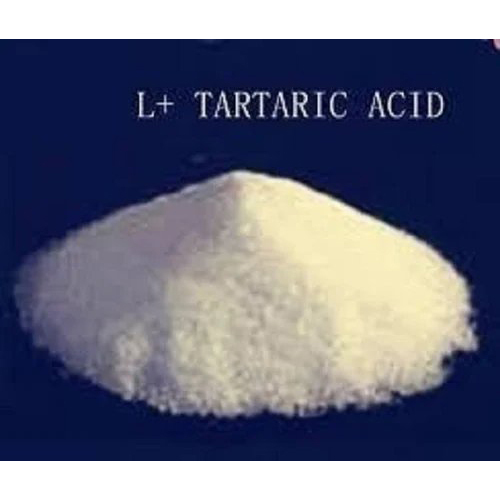
L-Tartaric Acid
200 INR/Kilograms
Product Details:
- Melting Point 170-172C
- Ph Level 1.0 (10 g/L, H2O, 20C)
- Ingredients L-(+)-Tartaric acid
- Physical Form Powder
- CAS No 87-69-4
- Structural Formula (CHOH)2(CO2H)2
- Taste Sour
- Click to View more
X
L-Tartaric Acid Price And Quantity
- 10000 Unit
- 200 INR/Kilograms
L-Tartaric Acid Product Specifications
- Acidulant, antioxidant, stabilizer, chelating agent
- 2 years
- 150.09 g/mol
- Odorless
- White crystalline powder
- In Water
- 29181980
- Food Grade, Pharmaceutical Grade, Industrial Grade
- Room Temperature
- Crystalline
- L-Tartaric Acid
- >=99%
- 1.79 Gram per cubic centimeter(g/cm3)
- 201-766-0
- NO
- 170-172C
- 1.0 (10 g/L, H2O, 20C)
- 87-69-4
- (CHOH)2(CO2H)2
- Sour
- L-(+)-Tartaric acid
- Powder
- C4H6O6
- Industrial
- Optically active; high purity; strong acidity; excellent chelating agent
- Decomposes before boiling
- <100 ppm
- <50 ppm
- 25 kg bags/drums or as required
- 0.5%
- 2.98, 4.34
- <10 ppm
- +12.0 to +13.0
L-Tartaric Acid Trade Information
- 100 Unit Per Day
- 2-3 Days
Product Description
| Packaging Type | Bag |
| Packaging Size | 25 kg |
| Form | Powder |
Tartaric acid is a white, crystalline organic acid that occurs naturally in many fruits, most notably in grapes, but also in bananas, tamarinds, and citrus.
Key Characteristics and Quality Standards
L-Tartaric Acid stands out with an impressive purity of 99% and strict controls on heavy metals (<10 ppm), chloride (<50 ppm), and sulphate (<100 ppm). It displays a specific rotation of +12.0 to +13.0, confirming its optical activity. Offered in pharmaceutical, food, and industrial grades, its excellent purity and stability make it suitable for demanding applications.
Applications Across Industries
This compound finds extensive use as an acidulant, antioxidant, stabilizer, and chelating agent. Whether enhancing flavor stability in the food sector or serving as a process aid in industrial and pharmaceutical applications, L-Tartaric Acid's strong acidity and water solubility allow versatile and reliable performance.
Safe Handling, Storage, and Packaging
L-Tartaric Acid is provided in robust 25 kg bags or drums, or customized packaging as needed. Non-poisonous and odorless, it should be stored at room temperature and kept dry to maintain its 2-year shelf life. Its loss on drying is 0.5%, further ensuring long-term effectiveness and safe handling.
FAQ's of L-Tartaric Acid:
Q: How is L-Tartaric Acid used in industrial and food applications?
A: L-Tartaric Acid serves as an acidulant, antioxidant, stabilizer, and chelating agent in the food, pharmaceutical, and industrial sectors. Its roles include correcting acidity in beverages, acting as a preservative, and enhancing the stability and quality of formulations.Q: What benefits does L-Tartaric Acid provide due to its high purity and specific optical rotation?
A: Its 99% purity ensures suitability for sensitive applications, while its specific optical rotation (+12.0 to +13.0) guarantees consistent performance in processes requiring optical activity, such as pharmaceutical synthesis.Q: When should L-Tartaric Acid be stored and handled, and what are the best storage conditions?
A: It should always be stored at room temperature in a dry container, away from moisture, to preserve its quality and 2-year shelf life. Handling is made easy as the product is non-poisonous and odorless.Q: Where can L-Tartaric Acid be sourced and what packaging sizes are available?
A: L-Tartaric Acid can be procured from distributors, suppliers, or traders in India. It is typically available in 25 kg bags or drums, with custom packaging options upon request for bulk or specialized needs.Q: What is the process for ensuring the product meets industrial safety and quality requirements?
A: Every batch undergoes rigorous testing for heavy metals (<10 ppm), chloride (<50 ppm), sulphate (<100 ppm), specific rotation, loss on drying, and meets the required purity of 99%. Compliance is ensured through documentation including CAS, EINECS, and HS code standards.Q: What are the main advantages of using L-Tartaric Acid as a chelating agent?
A: Its strong chelating properties allow it to bind metal ions effectively, preventing unwanted reactions, which is vital in food processing, pharmaceuticals, and industrial formulations. This enhances product stability and quality.Tell us about your requirement

Price:
Quantity
Select Unit
- 50
- 100
- 200
- 250
- 500
- 1000+
Additional detail
Mobile number
Email

Other Products in 'FOOD PRESERVATIVES' category


Sonipat, Haryana

- 582,, HSIIDC Industrial Area, Rai, Sonipat - 131029, Haryana, India
- Phone : 08045812334


 Send Inquiry
- Mr Naveen Jain (Director)
- Mobile :08045812334
- KAILASH CHEMICALS
(A UNIT OF SHANTI FOOD INDUSTRIES)
Marketing Office : 46 Phase -II Second Floor, Badli Industrial Estate Badli, Delhi-110042
Head Office Address : 582, Food Park HSIIDC Industrial Area Rai, Haryana - 131029


 Send Inquiry
 Send SMS
 Call Me Free
|

SHANTI FOOD INDUSTRIES
All Rights Reserved.(Terms of Use)
Developed and Managed by Infocom Network Private Limited.
Developed and Managed by Infocom Network Private Limited.

